
Your code: Git and GitHub
Every change is saved in a history, like an unlimited undo button, and several people can work on the same project without overwriting each other.

Your website or app is built, now it has to go online and stay online. I take care of servers, deployment, security and monitoring, and I explain everything in plain language.
Short answer: deployment means putting your website or app on a server so the whole world can use it. DevOps is the set of habits and tools that makes this fast, safe and repeatable, instead of a stressful manual operation every time you change something.
Longer answer: think of the opening night of a restaurant. Developers cook the dishes (the code). DevOps is everything behind the scenes: the kitchen equipment, the delivery of ingredients, the hygiene rules, the cameras and the alarms. Without it, even a great dish does not reach the table, or the kitchen catches fire at the worst moment. I take care of that part for React, Next.js and MERN applications.
No tech vocabulary required. If I use a technical word, I will translate it for you (there is a small dictionary further down this page, just in case).
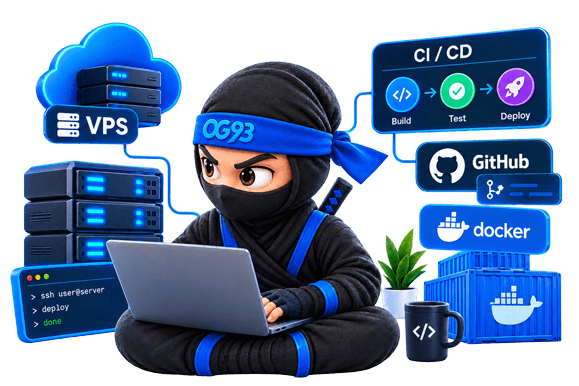
Here is the journey of your code, told simply:
Every change is saved in a history, like an unlimited undo button, and several people can work on the same project without overwriting each other.
Docker puts your app and everything it needs in a standard box (a container) that runs the same way on any computer or server. No more “but it works on my machine”.
A VPS (virtual private server) is a computer in a data center that runs your app day and night, with a web server (Nginx), your domain name and a security certificate (HTTPS).
A typical project combines several of these building blocks:
Preparing and hardening a VPS: users, SSH access, firewall and updates. A clean, secure foundation for your app.
Organized repositories, branches and review rules, so your project stays tidy, safe and easy to share.
Your app, database and other services packaged and started together with one command. The same setup in development and in production.
Automatic tests and deployment each time you push code: from a simple “git push” to a live site, without manual steps.
Your app online on your own domain, with a properly configured web server and a free security certificate that renews itself.
Automatic scans for vulnerabilities in your code and containers (Trivy, Snyk), server automation with Ansible, and dashboards and alerts with Prometheus and Grafana.
Beyond “it is online”, here is what changes for you:
Deploying becomes a routine, not a risky event. A change goes live in minutes, not after a nervous evening.
Automated tests and checks catch many problems before your visitors do.
HTTPS, updated servers, scanned dependencies and restricted access reduce the risk of being hacked.
Monitoring and alerts tell you about problems early, often before your customers notice.
A right-sized VPS and a simple setup help you keep your hosting costs clear and predictable.
Everything is documented and automated, so you, or another developer, can understand and maintain it later.
No black box. This is how a project usually goes:
I look at your app and where it runs today: the code, the hosting, the risks and what hurts. If you are starting from scratch, we define what you need.
I propose a simple setup (server, containers, domain, backups) and explain the costs, so you decide with full information.
I put your app and its services in Docker containers, so it runs the same way everywhere and is easy to move or restore.
I set up GitHub Actions so tests, build and deployment run automatically when you push code, with secrets handled safely.
I configure and harden the server, Nginx and HTTPS, scan for vulnerabilities and put your site online.
I add monitoring and alerts, plan updates and backups, and document everything so nothing depends on my memory.
DevOps has a lot of jargon. Here is the decoder:
A DevOps specialist connects development and operations: packaging the app, preparing the server, automating tests and deployment, securing everything and watching it run. The goal is to put changes online quickly, safely and without drama.
Not always. A simple showcase site can live happily on managed hosting. DevOps becomes valuable when your app is updated often, stores user data, needs several services (database, API, front end) or must stay available. I will tell you honestly what is overkill for your case.
Platforms like Vercel are excellent for simple Next.js apps and I use them when they fit. A VPS gives you more control: you can run your database and other services together, choose where your data lives and keep costs predictable. The right choice depends on your project, and I will recommend the simplest option that works.
It depends on the number of services, the size of the server, how much automation and monitoring you need, and whether you want ongoing maintenance. Tell me about your project and I will give you a clear quote, including the running costs of the server.
No system is 100% safe, but good practice reduces the risk a lot: HTTPS, regular updates, restricted access, scans for vulnerable dependencies, backups and monitoring. Even security tools can be attacked: in March 2026, the GitHub Action of a popular vulnerability scanner was briefly compromised. That is why automated pipelines should pin the tools they use to exact versions and keep permissions minimal.
With monitoring and alerts, you know quickly. I also prepare a way to go back to the last working version and regular backups. Whether you need someone on call around the clock is a separate conversation, and I will be honest about what I can offer.
Yes. I start with an audit to understand what is running, what is fragile and what is risky. Then we improve step by step, without breaking what works.
I trained in DevOps and CI/CD at Le Bon Développeur (Tunisia) between January and March 2026 (Linux, Git, Docker, GitHub Actions, deployment and security), and I apply it to React, Next.js and MERN applications, the stack I build with.
Real reviews from people I have worked with.
Wir als Online Marketing Agentur können OG93 als Freelancer und Partner sehr empfehlen. Kompetente Beratung, fachliches Know-How und kreative Prozesse sprechen für Oucema!
Online Marketing Agentur
Marketing agency
Professionnel, je recommande ce Web désigner pour la réalisation de vos sites et vos projets, Encore merci 👌👍👍👍
Meilleur Diag
Real estate diagnostics company
Travailler avec "Oucema Galaî" a été une expérience exceptionnelle du début à la fin. Son expertise en développement frontend et UX/UI Design est véritablement remarquable. Grâce à son talent et son dévouement, nous avons pu créer une application mobile à la fois performant et esthétiquement plaisant. Son sens aigu du design et son attention aux détails ont vraiment fait la différence. Je recommande vivement Oucema à quiconque recherche un travail de qualité supérieure. 5 étoiles bien méritées !
Nadim Gouia
Software Engineer
Je recommande vivement Ousssama Galai avec qui j'ai eu le plaisir de travailler sur un projet fullstack utilisant MERN a coding dojo. Je suis reconnaissant d'avoir eu l'opportunité de collaborer avec lui et je le recommande sans hésitation pour tout projet MERN
Khaled
Web developer
Tell me where your project stands: a finished app, a work in progress or an existing server that worries you. We will find the simplest safe setup. No jargon, no pressure.
Let's deploy