
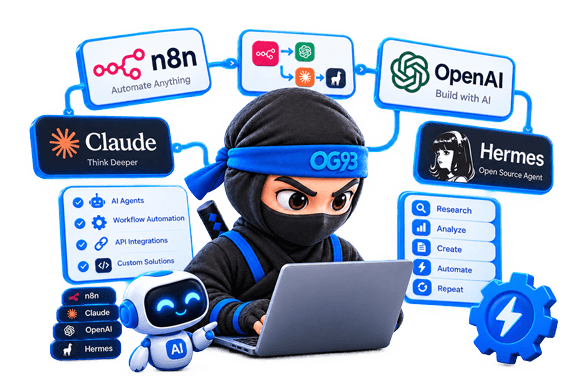
Workflows (n8n): the conveyor belt
n8n connects your apps and moves information between them following clear rules: when a form is filled in, add the contact, send a welcome email, notify the team. Fast, reliable and predictable.

Stop doing the same boring tasks by hand. I build AI agents and automated workflows that handle emails, leads, bookings and paperwork for you, and I explain everything in plain language.
Short answer: automation means letting software do your repetitive digital tasks for you, like sorting emails, sending reminders or copying data between apps. An AI agent goes one step further: it can read, understand and decide, so it can handle tasks that used to need a human brain.
Longer answer: picture a factory conveyor belt and a smart assistant. The belt (a workflow, built with n8n) moves things through fixed steps, fast and without mistakes. The assistant (an AI agent, such as Hermes Agent) understands a request, makes a judgment call and uses your tools to get it done. Put them together and part of your business runs smoothly while you do something else.
I help you find the tasks worth automating, build the system, and keep humans in charge of the important decisions. No tech vocabulary required, I translate as we go.
Two tools, two superpowers. Here is how I use them:
n8n connects your apps and moves information between them following clear rules: when a form is filled in, add the contact, send a welcome email, notify the team. Fast, reliable and predictable.
An agent understands messages and documents, decides what to do and uses tools to act: answer a customer, summarize a contract, plan a follow-up. It can remember context and work on tasks with some autonomy.
Workflows bring structure and safety, agents bring judgment. Combined, they handle messy real-life requests while staying under control.
Here are the most popular ideas. Your own project can mix several of them:
Sort your inbox, draft replies in your own tone, extract orders or requests and send follow-ups. You review what matters, the rest takes care of itself.
Find and qualify potential customers, complete their details and prepare personalized first messages, while respecting privacy rules.
A chatbot on your website that answers common questions instantly, collects the details and hands over to you when a human is needed.
Order updates, reminders, answers to common questions and bookings through the official WhatsApp Business platform, within Meta's rules.
Plan, draft and schedule posts, reuse your content across platforms and track what works. You keep the final say.
Read invoices, receipts, forms and contracts, extract the key data and send it to your accounting tool or spreadsheet automatically.
Keep your CRM up to date by itself, remind you of follow-ups, rate your leads and summarize every conversation.
Track your rankings and what your competitors publish, and receive a short, readable report instead of a hundred open tabs.
Let clients book, reschedule and get reminders on their own, synced with your calendar. Fewer no-shows, fewer back-and-forth messages.
Something that is not on this list? If a task is repetitive and digital, there is a good chance it can be automated. Let's talk about yours.
The goal is simple: less boring work for you, more time for what only you can do. Here is what changes:
Repetitive tasks (copying data, sorting emails, sending reminders) run by themselves, so you and your team can focus on work that needs a human.
Automations follow the same steps every single time. No forgotten follow-ups, no typos from copy-pasting.
Replies, bookings and alerts can run day and night, including weekends and holidays.
Handle 10 or 1,000 requests with the same system, without hiring for every busy period.
When it fits your needs, I set the tools up on a server you control, so you decide where your customer data lives.
Important actions can wait for your approval. The AI prepares, you decide when it matters.
No black box. Here is how a project usually goes:
You tell me which tasks eat your time. We list them and choose the best first candidate: frequent, boring and easy to describe.
We draw the process on paper: the steps, the rules, the exceptions and who approves what. If it is clear on paper, it will work in the machine.
I build the workflows in n8n and, where judgment is needed, an AI agent. I connect your tools: email, calendar, CRM, spreadsheets, WhatsApp and more.
I run it with real examples and awkward cases, and I add safety limits and approval steps for anything sensitive.
We go live with monitoring and alerts, so if something fails, you hear about it before your customers do.
We look at the results together and add the next automation. A good system keeps getting better as you use it.
Tech people love buzzwords. Here is the decoder:
Classic automation follows fixed rules: if this, then that. It is fast and predictable. An AI agent can understand free text, such as a customer email, decide what to do and use tools to act. Many projects combine both: workflows for structure and safety, an agent for judgment.
Almost any repetitive task that happens on a computer and follows a pattern: handling emails, qualifying leads, answering common questions, booking appointments, processing invoices, updating a CRM, posting content, monitoring competitors. If you do it again and again, it is a good candidate.
Not at all. You tell me what slows you down, I design and build the automation and show you how it works in plain language. You get simple instructions, and I can stay available if something needs to change.
It depends on the complexity, the number of tools to connect, how much AI is involved (AI models charge per use) and where it runs. A simple automation and a full AI assistant are very different projects. Tell me about your tasks and I will give you a clear quote, including running costs.
It can happen, which is why I design for it: limits on what the AI may do, approval steps for sensitive actions, logs of what happened and alerts when something looks wrong. The AI prepares, a human decides when it matters.
I tell you exactly which tools see which data, and I only share what is needed. When it fits your needs, I install the tools on a server you control, so your customer information does not depend on yet another third-party service. Also check what each AI provider does with data, I will help you choose.
In the European Union, generally yes: the AI Act's transparency rule, which applies since 2 August 2026, requires chatbots to tell people they are interacting with an AI, unless it is obvious. I build a clear notice and an easy way to reach a human. This is not legal advice, so check your own situation.
Yes, through the official WhatsApp Business platform. Meta's rules since 2026 allow bots built for a business purpose (support, bookings, order updates) but not open-ended, general-purpose AI assistants. I design your bot within those rules.
Real reviews from people I have worked with.
Wir als Online Marketing Agentur können OG93 als Freelancer und Partner sehr empfehlen. Kompetente Beratung, fachliches Know-How und kreative Prozesse sprechen für Oucema!
Online Marketing Agentur
Marketing agency
Professionnel, je recommande ce Web désigner pour la réalisation de vos sites et vos projets, Encore merci 👌👍👍👍
Meilleur Diag
Real estate diagnostics company
Travailler avec "Oucema Galaî" a été une expérience exceptionnelle du début à la fin. Son expertise en développement frontend et UX/UI Design est véritablement remarquable. Grâce à son talent et son dévouement, nous avons pu créer une application mobile à la fois performant et esthétiquement plaisant. Son sens aigu du design et son attention aux détails ont vraiment fait la différence. Je recommande vivement Oucema à quiconque recherche un travail de qualité supérieure. 5 étoiles bien méritées !
Nadim Gouia
Software Engineer
Tell me about the tasks that eat your day: emails, bookings, follow-ups, paperwork. We will find the best first automation together. No jargon, no pressure.
Let's automate